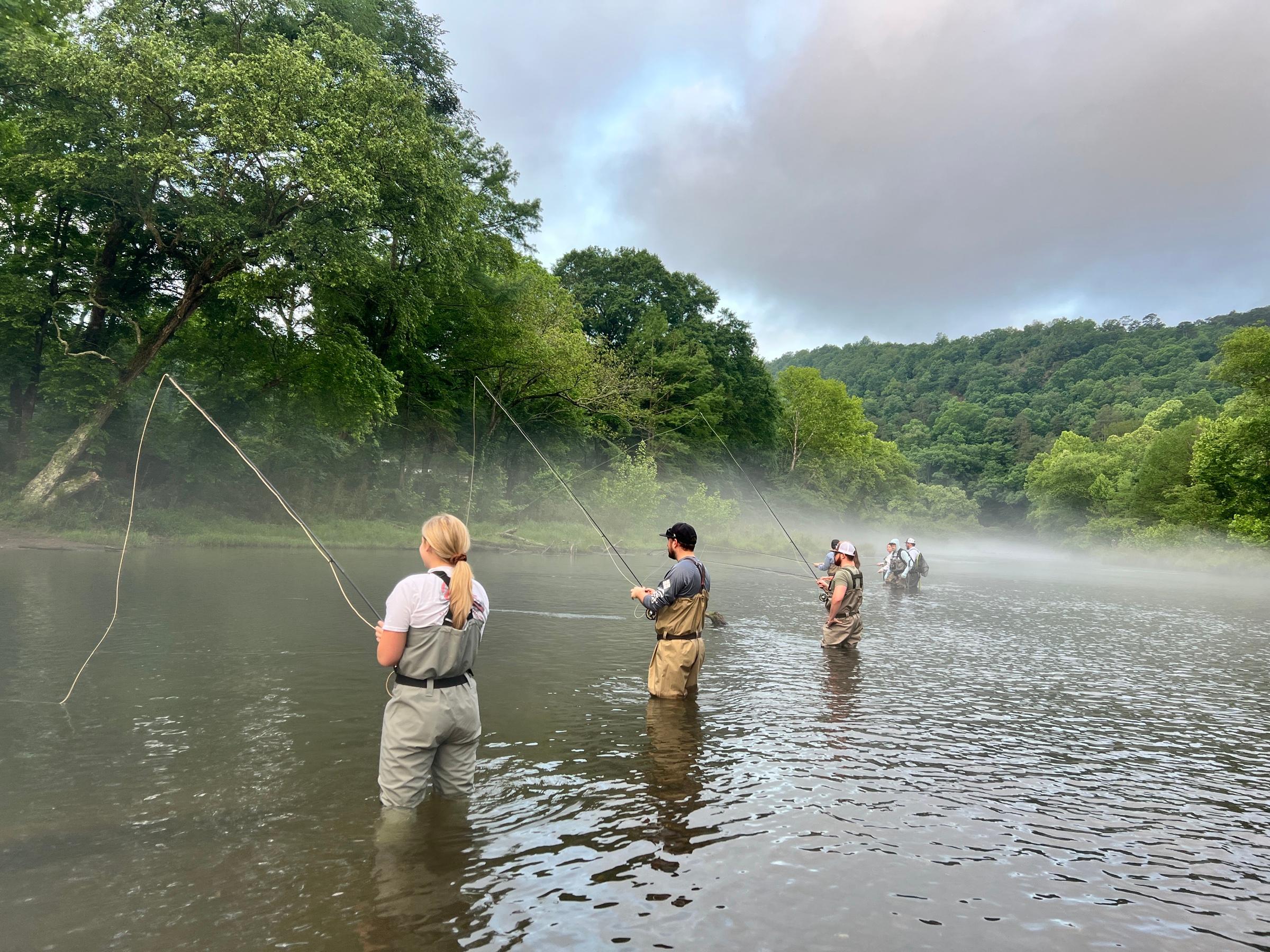
Oklahoma is a warmwater state.
For twelve miles, it isn't.
Two Oklahoma TU chapters are putting this river forward as a Trout Unlimited Priority Water.
That designation moves a river from somewhere volunteers work on weekends to somewhere an organisation commits to for the long haul. Getting it takes evidence. This site is where we keep ours.
Broken Bow Dam
Water leaves the bottom of the reservoir instead of the top, and it leaves cold. That single engineering detail is the only reason trout live in this state. Everything downstream depends on it.
What the river carries
Broken Bow Dam down to the US-70 bridge, about five of those miles inside Beavers Bend State Park.
Nobody has published a creel survey for this river. Getting one is near the top of our list.
Needs sourceNo regional economic study of this fishery exists yet — though it is the closest year-round trout water to Dallas–Fort Worth, roughly 200 miles away.
Needs sourceUnusual this far south. Most Oklahoma trout water is seasonal put-and-take; the dam releases cold water from the bottom of the reservoir all year.
A river this narrow has no margin.
Every spike is a hydropower release. Between them the river falls away to baseflow. This is one ordinary week — not a flood, not a drought — and the fish live through all of it.
- 01
Generation surges
Hydropower releases are scheduled for the grid, not for the fishery. Flows can swing fast enough to strand fish, scour redds, and put a wading angler in trouble.
- 02
Heat, in a dry year
The cold comes from deep in the reservoir. Draw the lake down far enough in a long summer and the coldwater reach contracts from the bottom up.
- 03
What's being built
The corridor around the river is one of the fastest-growing tourism areas in the state. More cabins means more septic, more runoff, more cleared bank.
- 04
Sediment
Erosion fills the gravel that trout spawn in. It is slow, unglamorous damage, and it is the kind that is hardest to undo once it is done.
There is a hole in the map,
and we are standing in it.
Trout Unlimited's Priority Waters map covers 32 states. Eighteen have none at all, and they are not scattered — they sit together through the middle and south of the country. Oklahoma is one. So are Texas, Arkansas, Missouri, Kansas and Louisiana, every one of them a neighbour.
TU describes its approach as a portfolio — spreading risk for trout and salmon across a variety of habitats and populations. A year-round coldwater tailwater at the southern edge of where trout can live is not more of what the portfolio already holds. It is the kind of thing a portfolio is missing.
We are not asking to be ranked above a river in Montana. We are asking why an entire region of the country has nothing on the map at all.
An empty state can mean two things: that TU looked and found nothing that met the bar, or that the state-by-state work simply never ran there. Those lead to very different conversations, and we would rather ask than assume.
Everything here
has to be checkable.
A reviewer at Trout Unlimited has limited time and no reason to take our word for anything. So the library grades its own sources, says plainly which documents nobody has obtained yet, and separates what the state has published from what a guide told a magazine.
- Documents in hand
- 5
- Still to obtain
- 17
- The one that decides it
- A study showing trout spawn here on their own. Trout Unlimited's language is wild and native — so that single document is worth more than everything else in the library put together.
Put your name
on this river.
Trout Unlimited weighs local support when it decides where to commit. Every name and ZIP code on this list is part of the record we submit.
The list isn't open yet.
We would rather not take your details than take them and lose them. Sign-ups open as soon as the list has somewhere proper to live — check back, or catch one of the chapters at a meeting in the meantime.